Fictional examples welcome. You never need to disclose your income, bills or family circumstances.
Talk first
If a pay rise is below inflation, is calling it a pay rise misleading?
Which would you protect in a tighter budget: convenience, quality, social life or savings?
The economy at the checkout
An economy can look healthier in a national report than it feels at the checkout. That does not automatically mean the figures are wrong. Gross domestic product, or GDP, measures production; inflation measures changes in prices; a household budget reveals whether one particular set of commitments is affordable. These measures answer different questions. Confusing them makes it harder to understand why some people feel squeezed while others are comfortable.
Start with the difference between the inflation rate and the price level. If annual inflation falls from 6% to 3%, prices are still rising overall. They are simply rising less quickly. The earlier increase has not disappeared. A family trying to make ends meet may care much more about the total increase since its last substantial pay rise than about this month’s headline rate.
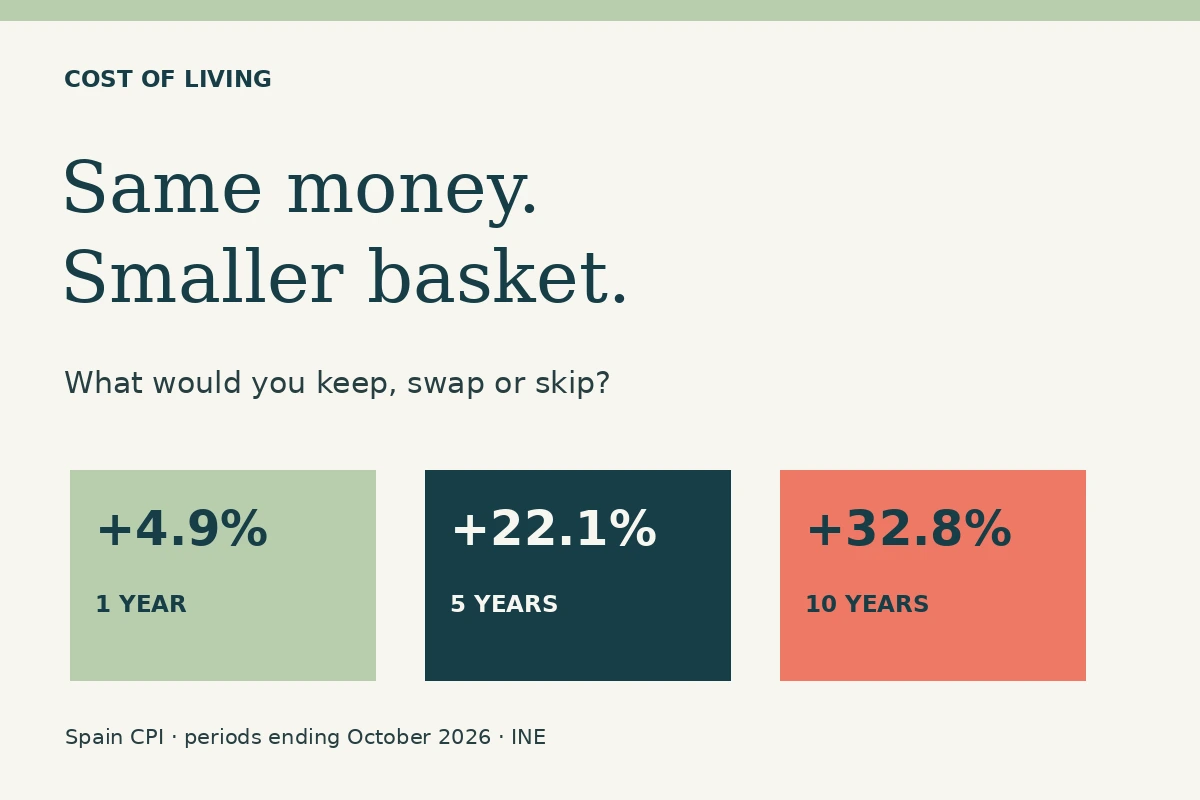
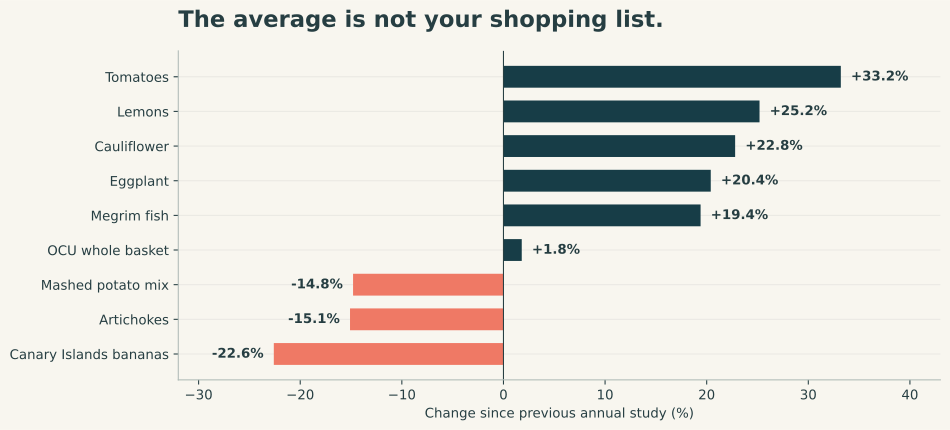
The data cards compare Spain’s general CPI over matching months and OCU’s supermarket findings over its own study period. They should not be merged into a single ranking. A supermarket basket covers different products from a general index, and selected dramatic price rises are not an average. Nor does the broad housing category tell us how much buying a home has increased. Asking what was measured is part of understanding the story.
People respond by shopping around, cutting back and making do. Some choices reduce waste with little loss of enjoyment; others reduce comfort or social participation. Switching brands can be sensible, but the cheapest item may not offer the lowest unit price or the best fit for someone’s needs. Bulk buying ties up cash, while a cheaper store can involve a longer journey. Savings have costs in time, effort and access as well as money.
The comparison with pay is equally important. Nominal wages are measured in money; real wages adjust for price changes. A national average can improve without restoring earlier losses, and it can hide differences between sectors or workers. Someone earning more because they work additional hours has not necessarily gained a better hourly rate. The figures should prompt questions rather than dismiss people’s experiences.
Government action involves tradeoffs. A carefully designed temporary price cap might cushion a shock, but an unsustainable ceiling could reduce the incentive to supply a product. Targeted support can help those most exposed, although application rules may exclude people who need it. Tax reductions may ease costs if businesses pass them on, but they also reduce public revenue. Competition measures can address market power, while offering limited immediate relief.
The most useful question may be less “Why don’t people budget better?” and more “Which costs can they realistically change?” Protecting one small pleasure can be a deliberate choice, not evidence of irresponsibility. A credible response should make room for both practical household decisions and the wider conditions that shape them.
Device voice; no downloadable recording.
Original classroom writing. Research snapshot: 13 November 2026.
The story in three charts
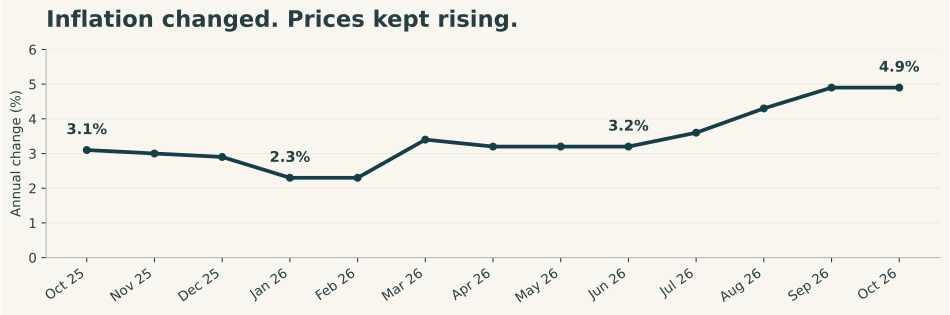
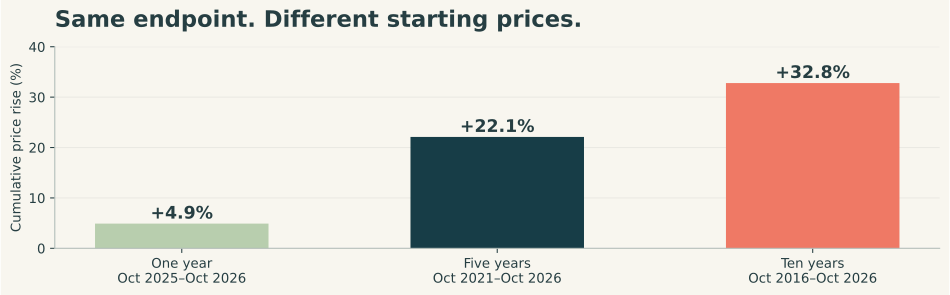
Spain · annual CPI rate, each month compared with the same month a year earlier. These are not month-on-month increases. INE; October 2025–October 2026. Latest release: 13 November 2026.Spain · national general CPI, same-month comparisons ending October 2026. One year: +4.9%; five years: +22.1%; ten years: +32.8%. The periods overlap: do not add them. Illustrative equivalent of a €100 basket: €104.90, €122.10 or €132.80, respectively. Not the prices of a specific grocery list.
Describe the change in the annual CPI rate without claiming prices fell when the rate fell.
Compare the OCU result with October CPI. Give two reasons this is not a like-for-like comparison.
Why would a €100 basket example be misleading if described as everyone’s grocery bill?
Do not add overlapping periods. A slowing positive rate is not a falling price level.
Selected products from OCU’s 2026 annual supermarket study compared with its previous study. Prices collected April–May 2026. Percentage changes, not euro prices; selected examples are not a representative average. The whole basket also includes household and hygiene products.
The headline figure conceals differences between ___.
The saving needs to be weighed against ___.
A cap could help in the short term, but ___.
I would prioritize ___, even if that meant ___.
Find the evidence
Why can GDP and a difficult household budget coexist?
Does inflation falling from 6% to 3% reverse earlier increases?
Why might bulk buying fail to help?
What condition affects whether a tax cut helps shoppers?
Answer in pairs and identify a supporting sentence. Keep opinion separate from a reading fact.
Budget food, with a side of economics
Hamburger Helper is a US boxed pasta-and-sauce mix, cooked with added ingredients such as ground beef and milk to make the meat go further. Along with the familiar student staple of instant ramen, it offers a lighthearted way into budget meals. A 2025 Daily Economy opinion article interprets demand for cheaper meals as a clue to pressure missed by headline growth. The “index” is informal: sales alone cannot establish why people buy something. What do you eat on a budget?
Spain, Q2 2026 vs Q2 2025: average gross wage cost per worker rose 4.0%; CPI annual rates were 3.2% in April, May and June. Using these rounded figures gives approximately 0.8% real growth: 1.04 ÷ 1.032 − 1. This is a broad average comparison—not each worker’s pay raise, median earnings or take-home income.
In an ONS survey of adults in Great Britain in August 2026, 59% reported spending less on non-essentials because of rising living costs, 43% shopping around more and 38% spending less on food shopping and essentials. These are self-reports, not Spanish statistics; people could take more than one action.
A worker receives 3% more pay while their usual basket costs 5% more. Has the pay rise improved what they can buy? What else would you want to know?
Optional authentic listening
Federal Reserve Education · Inflation
Watch only the opening three minutes, or stop earlier after the basket explanation. Historical prices are examples from the video, not today’s prices. This is a US explainer; its policy target and methodology require context.
What is the difference between a low nominal price and affordability?
What can a basket show that a single product cannot?
No playback? Teacher-read alternative
Inflation is a broad increase in prices over time. A low price in the past does not prove something was easier to afford, because pay was different too. A price basket combines many purchases. It describes an average pattern, while households spend their money differently.
Official page and transcript checked; video playback has not been verified here. The fallback is original classroom narration, not an authentic transcript.
What would you protect?
What meal stretches a budget without feeling like a sacrifice?
When does convenience justify paying more?
How can someone reduce food waste without buying unnecessary gadgets?
Which purchases are most likely to be a false economy?
Would you protect a small regular treat or an occasional expensive experience?
Which cutback might increase isolation?
How should couples or housemates negotiate different priorities?
When is it reasonable to reduce savings instead of current spending?
What can average wage growth hide?
Should inflation-linked pay rises be a legal right or a bargaining goal?
How should part-time work and hours be handled in comparisons?
What is missing from a headline saying consumers are spending more?
When could a temporary price cap be justified?
What would make a targeted payment fair and accessible?
How could we test whether a tax reduction reached shoppers?
Where should household responsibility end and public responsibility begin?
Although ___ has improved, ___ remains a problem.
The headline figure conceals differences between ___.
The saving needs to be weighed against ___.
A cap could help in the short term, but ___.
I would prioritize ___, even if that meant ___.
Keep, swap or skip
Redesign the fictional budget to absorb an €80 rise in essential costs. Calculate savings, identify two hidden costs and protect one quality-of-life priority. Then choose one public policy that would help this household and explain one possible downside.
Item
Euros per month
Housing and bills
€1050
Food and household goods
€420
Transport
€160
Health and essential care
€90
Phone and internet
€60
Social life and subscriptions
€120
Savings / emergency buffer
€100
Income €2,100 · current spending €2,100 · new cost €80.
Possible changes—fictional estimates, not guaranteed savings
Possible change
Monthly saving
Switch some brands / reduce food waste
€25
Cancel one subscription
€15
Two fewer takeout meals
€30
Walk or use an existing bus pass for suitable trips
€20
Renegotiate phone plan
€10
Delay a non-urgent purchase
€30
Reduce the savings contribution this month
€40
Compare quality, time, transport and access. Do not cut essential care or recommend skipping meals.
Final outcome: Agree on a plan, defend one protected priority and explain a tradeoff.
Although ___ has improved, ___ remains a problem.
The headline figure conceals differences between ___.
The saving needs to be weighed against ___.
A cap could help in the short term, but ___.
I would prioritize ___, even if that meant ___.
Should the government step in?
Compare the three options. What problem do you want to solve first?
Temporary price ceiling
Set a legal maximum for selected essential goods. It may provide immediate relief; if set below a viable supply price without support, it can discourage supply or create shortages. Define the product, duration and enforcement.
Targeted support
Give eligible households cash or vouchers. This can focus help on need; eligibility rules, missed applicants, funding and price effects need attention.
Tax relief and competition
Reduce selected consumption taxes or improve competition and price transparency. Benefits depend on how much reaches shoppers; tax cuts cost public revenue and competition measures can take time.
Who benefits? Who pays? What could go wrong? How would you check whether it worked?
Take it further
Create two accurate headlines for the same chart: one reassuring and one concerning. Identify what each highlights and what readers still need to know.
Exit ticket
One useful expression. One claim you can support with data. One choice or opinion you reconsidered.