Fictional examples welcome. You never need to disclose your income, bills or family circumstances.
Talk first
Your friends choose an expensive place to meet. What could you suggest without making anyone feel awkward?
Keep your current phone, buy secondhand or save for a new one: what changes your answer?
Your money has entered hard mode
The price is small. The problem is that every price is small: a bus trip, a snack, a subscription and something to do with friends. Add them together and the money disappears. The cost of living is the money people need for everyday life. Teenagers may not pay every household bill, but prices can still change where they go, what they buy and whether a plan includes everyone.
Inflation is a broad rise in prices. It does not mean every product becomes more expensive, and a lower inflation rate does not automatically mean prices have fallen. If a snack rises from €1 to €1.10 and then to €1.12, the second increase is slower—but the snack has not returned to €1. The example is fictional. Our charts show real Spanish data, with the dates and sources clearly labeled.
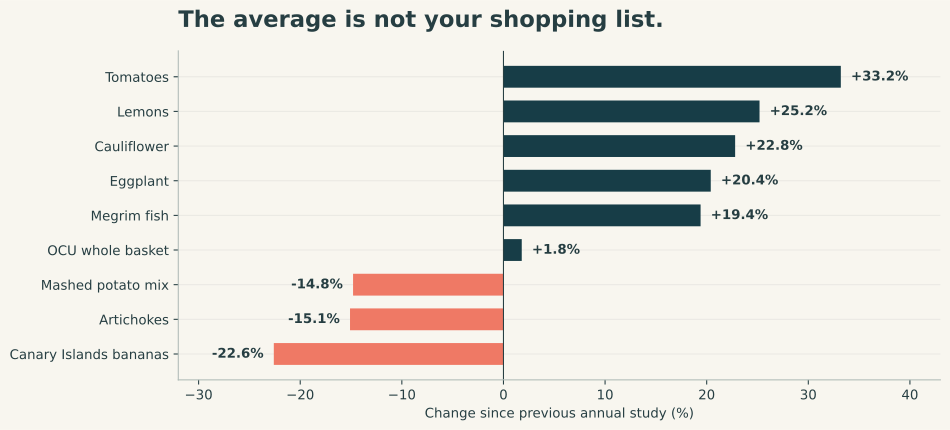
The OCU chart compares selected supermarket products with the previous annual study. OCU is a Spanish consumer organization. Some products rose sharply while others fell. Its whole-basket figure is different from the general inflation rate because the products and study periods differ. Before sharing a dramatic price post, check whether it describes one item, a basket or the whole economy.
Making a budget stretch means making your money cover more. You might shop around, cut back on deliveries or make do with the headphones you already own. That is different from going without headphones completely. Buying the cheapest thing can be a false saving if it breaks quickly. Buying a huge pack can also be a bad deal when you do not need all of it.
Budget choices are also social choices. Imagine four friends want to meet. One suggests a restaurant, another suggests cooking together, and a third stays quiet because both plans are difficult. A good solution might be a free activity where bringing food is optional. Nobody should have to explain their family’s finances to belong to a group.
Adults face another problem: a pay raise can be smaller than the rise in prices. More euros do not always buy more things. Governments can consider help for households, changes in taxes or limits on some prices. Each option has costs and questions. Your task is to explain a choice, listen to a different priority and decide what would make the plan fairer—not to find the one correct opinion.
Device voice; no downloadable recording.
Original classroom writing. Research snapshot: 13 November 2026.
The story in three charts
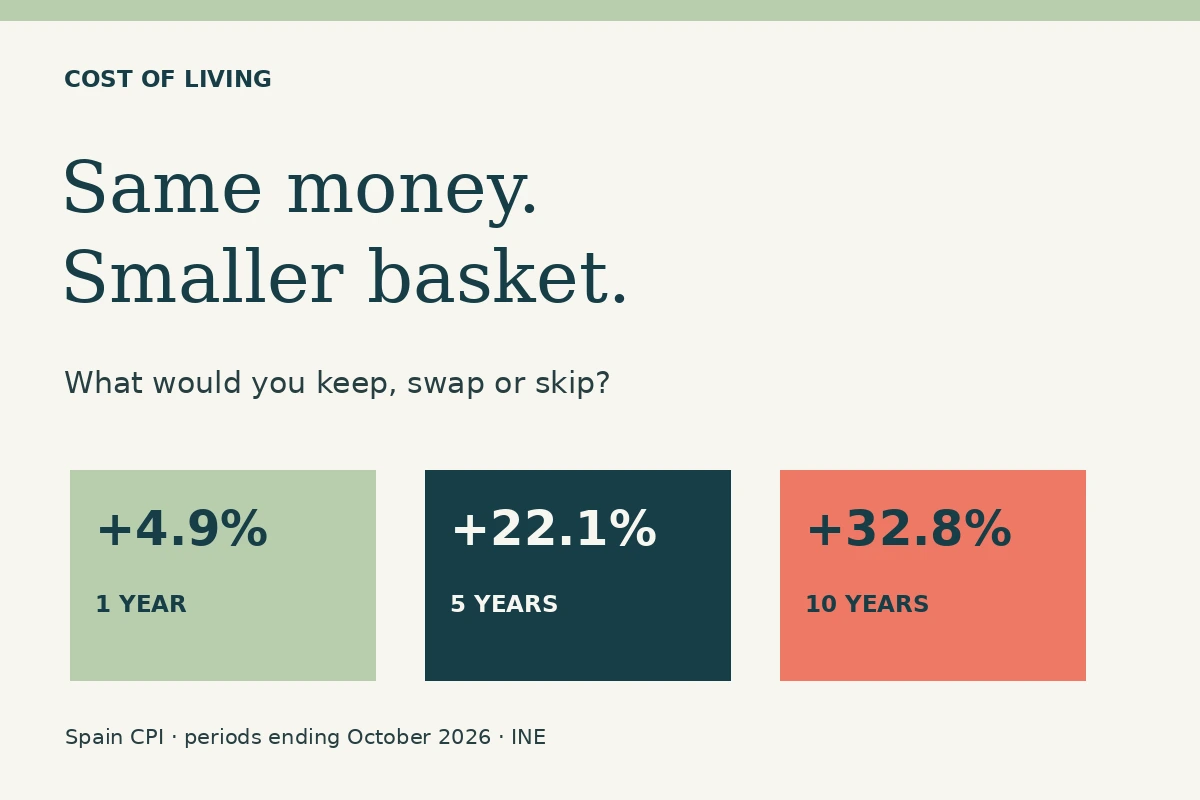
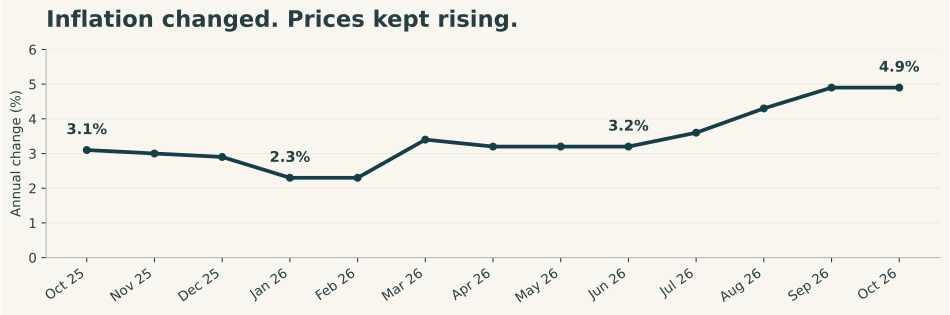
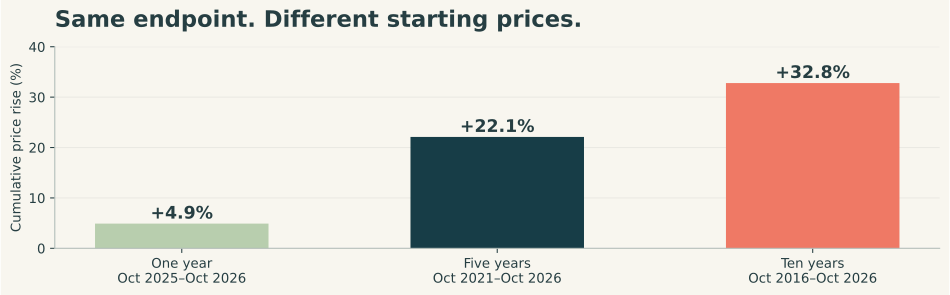
Spain · annual CPI rate, each month compared with the same month a year earlier. These are not month-on-month increases. INE; October 2025–October 2026. Latest release: 13 November 2026.Spain · national general CPI, same-month comparisons ending October 2026. One year: +4.9%; five years: +22.1%; ten years: +32.8%. The periods overlap: do not add them. Illustrative equivalent of a €100 basket: €104.90, €122.10 or €132.80, respectively. Not the prices of a specific grocery list.
Compare tomatoes with the whole OCU basket. Why are the percentages different?
What happened to the annual inflation rate between October 2025 and October 2026?
Why should we not add the one-, five- and ten-year figures?
Do not add overlapping periods. A slowing positive rate is not a falling price level.
Selected products from OCU’s 2026 annual supermarket study compared with its previous study. Prices collected April–May 2026. Percentage changes, not euro prices; selected examples are not a representative average. The whole basket also includes household and hygiene products.
I see your point, but that would be harder for ___.
Find the evidence
Does slower positive inflation return a snack to its original price?
Why can the cheapest item be a bad deal?
Why might a large pack be a poor choice?
Should friends need to disclose family finances to join a plan?
Answer in pairs and identify a supporting sentence. Keep opinion separate from a reading fact.
Budget food, with a side of economics
Instant ramen is a familiar US college-budget meal: quick noodles with a seasoning packet. Hamburger Helper is a boxed pasta-and-sauce mix that stretches added ground beef into a bigger meal. A 2025 opinion piece uses budget-food sales as a clue that money may be tight—not an official “index.” Your turn: what is your go-to cheap meal? What could you add to make it better without spending much?
Real example, Spain: in April–June 2026, average gross pay costs rose faster than the general price index compared with a year earlier. That does not mean every worker received a raise. A different worker may still have less money left after bills.
In an ONS survey of adults in Great Britain in August 2026, 59% reported spending less on non-essentials because of rising living costs, 43% shopping around more and 38% spending less on food shopping and essentials. These are self-reports, not Spanish statistics; people could take more than one action.
A worker receives 3% more pay while their usual basket costs 5% more. Has the pay rise improved what they can buy? What else would you want to know?
Optional authentic listening
Federal Reserve Education · Inflation
Watch only the opening three minutes, or stop earlier after the basket explanation. Historical prices are examples from the video, not today’s prices. This is a US explainer; its policy target and methodology require context.
What other information would you need before saying life used to be cheaper?
No playback? Teacher-read alternative
Inflation is a broad increase in prices over time. A low price in the past does not prove something was easier to afford, because pay was different too. A price basket combines many purchases. It describes an average pattern, while households spend their money differently.
Official page and transcript checked; video playback has not been verified here. The fallback is original classroom narration, not an authentic transcript.
What would you protect?
What can you cook when money is tight?
What is the student-budget meal in your country?
How would you improve instant noodles without making them expensive?
Which food is worth paying a little more for?
Would you rather keep subscriptions or save for days out?
Which purchase can wait without causing a problem?
When is buying secondhand a good choice?
What makes a cheap item bad value?
How can you suggest a cheaper plan without embarrassing anyone?
Should a group always choose a plan everyone can afford?
What does free entertainment still cost in time, travel or equipment?
Which school activity should never depend on a student’s budget?
Should a teenager’s allowance rise when prices rise?
Which price would you ask the government to focus on first?
Could a price limit help shoppers but create a problem for a shop?
What information should a price comparison show before you trust it?
I used to ___, but now I ___.
We could cut back on ___ without giving up ___.
I would rather ___ than ___ because ___.
This saves money, provided that ___.
I see your point, but that would be harder for ___.
Keep, swap or skip
Four friends have a shared fictional budget of €24 for an afternoon. Compare three plans: a café (€20 plus €8 transport), a picnic (€14 plus €6 transport), and a free local event (€0 plus €10 optional snacks). Agree on a plan that includes everyone. Explain what you keep, swap or skip; nobody must buy optional food.
Twist: One friend cannot travel outside the local area. Revise the plan without asking why.
Final outcome: Agree on a plan, defend one protected priority and explain a tradeoff.
I used to ___, but now I ___.
We could cut back on ___ without giving up ___.
I would rather ___ than ___ because ___.
This saves money, provided that ___.
I see your point, but that would be harder for ___.
Should the government step in?
Compare the three options. What problem do you want to solve first?
Limit some prices
The government sets a maximum price for a few important products. This can help shoppers. But shops must still pay for products and workers. What if the maximum price is too low?
Give extra help
The government gives money or food vouchers to people who need help. Who should receive it? How can people apply easily?
Reduce taxes or improve choice
Lower taxes on some products could reduce prices if shops pass the saving on. More choice between shops could help too. How would we check that shoppers benefit?
Who benefits? Who pays? What could go wrong? How would you check whether it worked?
Take it further
Create a 30-second “money tip that actually helps” pitch. A partner adds a constraint: no freezer, no car or little free time. Improve the tip.
Exit ticket
One useful expression. One claim you can support with data. One choice or opinion you reconsidered.