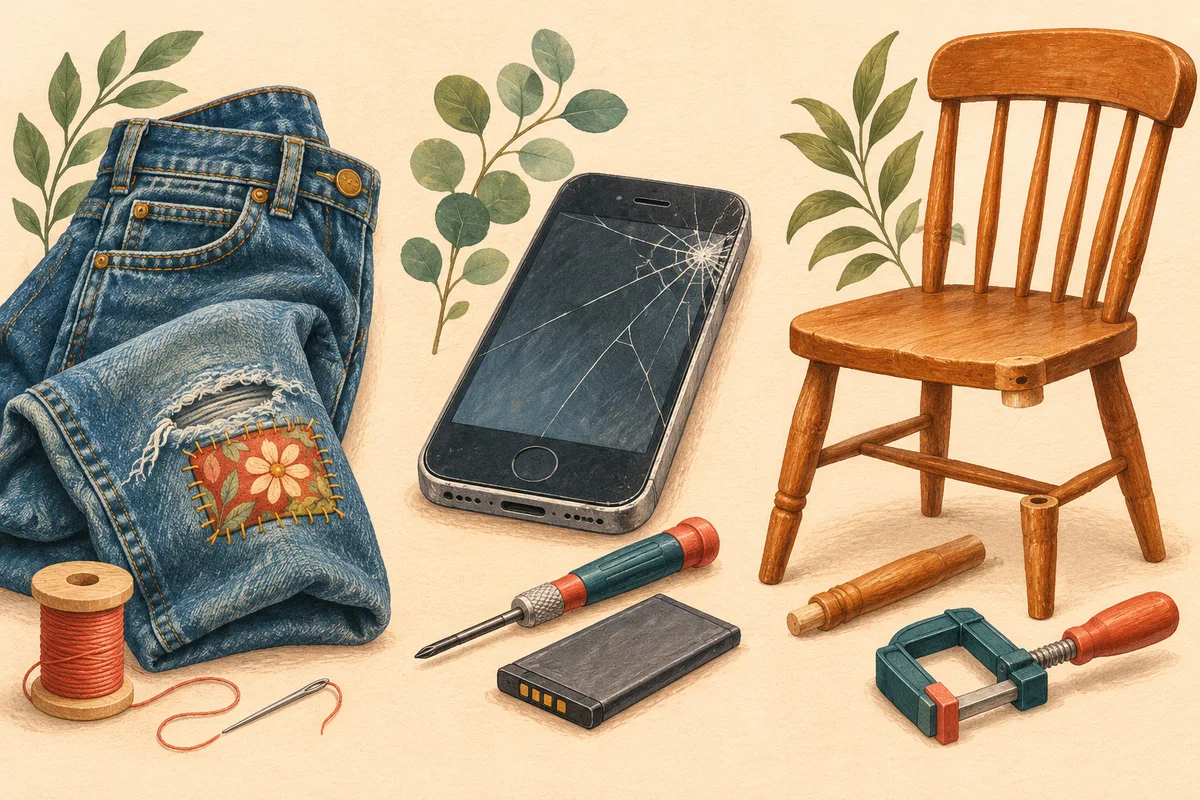
Three everyday objects. Which would you fix, replace or keep using?
What is the oldest thing you use every week?
Can you sew on a button or fix a small problem at home?
What skill do you wish you knew?
Original, source-informed reading · A2
Can we fix it?
Mia has an old blue jacket. She likes it, but the zip is broken. A new jacket costs 65 euros. A new zip costs 12 euros. What should she do?
Many years ago, people often repaired clothes and household objects. They sewed buttons on shirts and fixed chairs. Some people still do these things, but others buy something new when an object breaks.
Today, new things can be cheap. Repairs sometimes cost a lot of money. People are also busy, and not everyone knows how to repair things. Some broken objects are difficult or unsafe to fix at home.
In a Repair Café, people bring broken things and volunteers try to help. They can also show visitors how to use tools or sew. Not every object can be repaired, but people can learn useful skills.
What about old clothes? A small hole does not always mean the end of a T-shirt. You can sew it or ask for help. Using a favourite shirt for longer can save money and reduce waste.
Mia decides to repair the zip. She wants to wear her jacket again. What can you repair? What would you like to learn?
This is original classroom writing, not a reproduction of a news article.
Factual policy claims are linked to official sources below.
Before: Look at your clothes. Can you see a button? Have you ever lost one?
During: Watch how the person uses the needle, thread and button. Name three things you see.
After: Would you like to try this? Tell a partner one skill you want to learn.
No video? Use the fact card
A shirt loses a button. A person uses a needle and thread to sew it back on. The shirt is ready to wear again.
Optional / Cultural context
Home Economics & Shop classes in the US
In many US schools, Home Economics traditionally covered cooking, sewing, budgeting and household life, while Shop or Industrial Arts classes taught tool use, woodwork, metalwork and practical construction. Their availability varied and related subjects still exist, sometimes under the names Family and Consumer Sciences or Career and Technical Education. Spain has Technology and Digitalisation subjects and vocational routes, but no universal one-to-one equivalent of traditional US Home Ec.
Discuss: What skill do you wish you knew?
Who should teach it?
05 / Say what you really think
A conversation worth having
Work in pairs. Listen actively, ask why and respond to each other's ideas.
Do you repair clothes or buy new ones?
Who is good at fixing things in your family?
Which broken things should you never try to repair without an expert?
Is it better to buy one strong bag or three cheap bags?
Would you visit a Repair Café?
What skill do you wish you knew?
The old toaster has been waiting for its comeback.
Do you repair clothes or buy new ones?
06 / Your group has a decision to make
The repair-or-replace shop
Your group has 80 euros. A jacket zip costs 12 euros to repair or 65 euros to replace. A chair costs 20 euros to repair or 45 euros to replace. Choose what to do and explain why.
Before you decide, consider three things:
RepairCan it be fixed safely?
CostIs fixing it worth the money?
WasteWhat happens if you replace it?
Customer
You like your old things. You want to save money.
Repair helper
You can repair the jacket and chair. Explain the prices.
Friend
You want things that are safe and work well.
Final outcome: Agree on a plan for both objects. Say how much money you spend and give two reasons.
Useful language
It is broken.
We can fix it.
It costs ... euros.
I prefer ... because ...
Let's repair / replace ...
Optional · Student curiosity corner
Keep Exploring · Read & Watch More
Curious about this topic? Choose one original article or video.
These are optional, not homework. Some are more challenging than the class reading.
Read · A2+ · 5 min
Repair Café International
Explore a community approach to sharing practical repair skills.