Ready-to-teach lesson · C2 · Proficiency · 60 minutes

The Repair Revolution: Should durability be a legal obligation?

Interrogate competing economic and legal claims and defend a proportionate, enforceable repair framework.

01 / Talk first · 6–8 minutes

Before we read

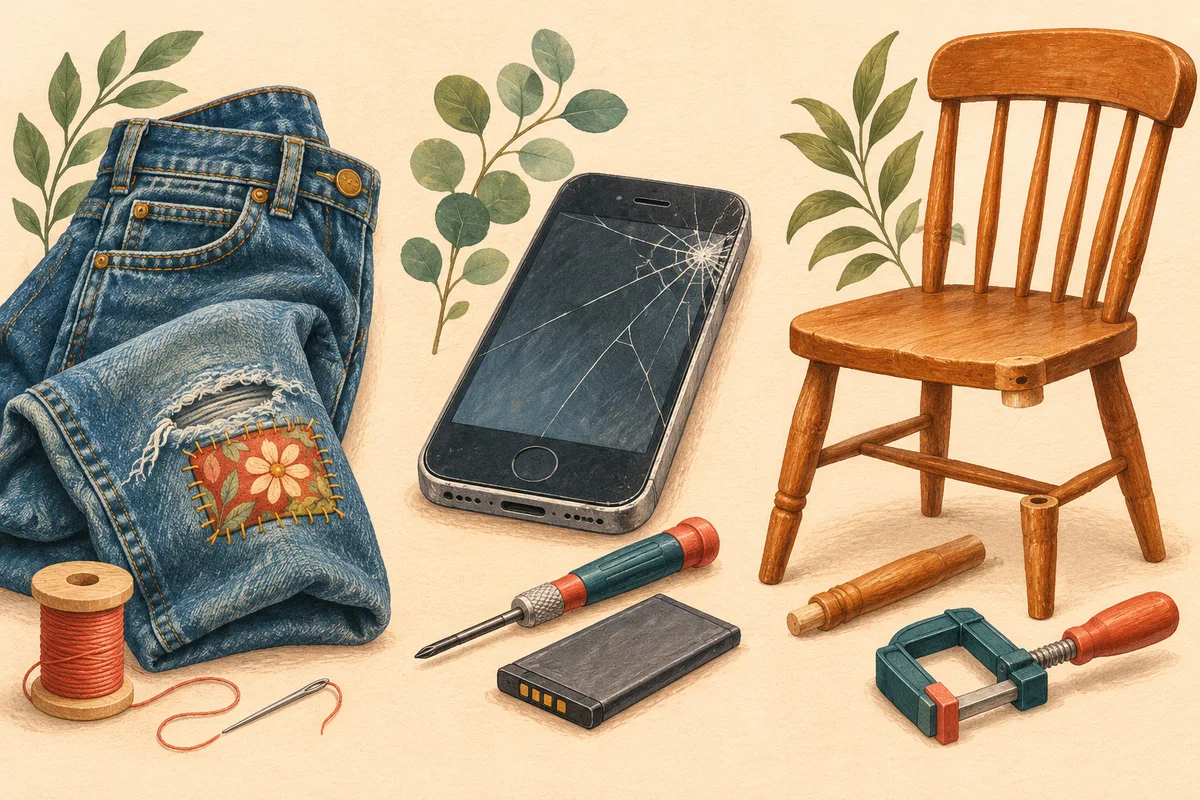
Illustration of patched jeans, a phone with a cracked screen and a wooden chair with a loose leg, with repair tools alongside them
Three everyday objects. Which would you fix, replace or keep using?
  1. Can ownership be meaningful if a manufacturer controls the means of repair?
  2. Is a legal duty to make products durable economically defensible?
  3. What would count as compelling evidence of deliberate, rather than accidental, obsolescence?
Original, source-informed reading · C2

The durability paradox: whose product, whose rules?

A consumer purchases a machine, yet its useful life may depend on decisions made long after the transaction: whether the manufacturer stocks a replacement component, releases a software update or permits an independent technician to run a diagnostic tool. Ownership, in other words, need not confer meaningful control over maintenance. Right-to-repair campaigns exploit that tension, but the legal and economic questions it raises resist the tidy opposition of virtuous fixers and cynical corporations.

The familiar claim that products were once 'built to last' combines a genuine concern with a selection effect. Durable examples remain in households and museums; failed equivalents are less visible. Modern engineering has also delivered safer appliances, lower energy consumption and compact devices whose construction may be inherently more complex. None of this absolves manufacturers of deliberate anti-repair design. It does, however, make a broken product an inadequate substitute for evidence of planned obsolescence. The relevant tests are intentionality, feasible alternatives, documented restrictions and the consequences for consumers.

At least three mechanisms warrant separation. Technical obsolescence occurs when components fail or software support ceases; it may be preventable or unavoidable. Economic obsolescence arises when repair costs exceed replacement costs, even though a product remains physically repairable. Perceived obsolescence is driven by taste, fashion or status: a perfectly functioning device is displaced by something newer. Fast fashion exemplifies the latter, although garment quality, supply-chain practices and disposal introduce additional material harms. Treating all three as identical encourages sweeping remedies that may miss their target.

The EU's 2026 measures offer a more incremental policy experiment. From 31 July, the directive promoting repair has applied through national law, requiring manufacturers to offer repair for specified products covered by existing EU reparability requirements, within a reasonable period and at a reasonable price unless free. A qualifying consumer choice of repair rather than replacement during the seller's liability period brings at least a twelve-month extension. Separately, consumer-law changes applicable from 27 September target misleading durability claims and certain premature-obsolescence practices. Product-specific requirements for newer smartphones and tablets include repairability information, parts availability and extended software support. These instruments overlap in purpose but differ markedly in scope and enforcement.

A manufacturer may invoke safety, cybersecurity, intellectual property or warranty integrity to defend controlled access. Some concerns are legitimate: a poorly installed battery can be hazardous, and unrestricted software changes can compromise a connected device. Yet proprietary control can also exclude independent repairers, create captive aftermarket demand and increase the cost of ownership. A defensible regime must distinguish necessary safeguards from restrictions whose commercial convenience is presented as a technical necessity.

Distributional effects complicate the apparent win-win. Requiring every small producer to maintain expensive inventories and documentation for years may entrench well-capitalised incumbents. Conversely, allowing large brands to monopolise tools and parts can strangle local repair businesses. A longer-lasting product may command a higher upfront price, placing it beyond the reach of consumers who would benefit most from its lower lifetime cost. Repair incentives might create skilled jobs and reduce material extraction; badly designed subsidies could merely reimburse people who would have repaired anyway.

The environmental calculus likewise needs a counterfactual. Extending a product's life avoids some manufacturing impacts, but an exceptionally inefficient appliance can consume enough extra energy to change the balance. Repair activity uses parts, transport and labour, while rapid replacement produces further waste. A credible lifecycle comparison specifies the alternatives, expected remaining years, usage intensity, energy mix and realistic repair outcomes. 'Repair is always greener' is no more analytically robust than 'newer is always better'.

A subtler barrier is the erosion—or uneven distribution—of practical competence. Traditional US Home Economics and Shop courses taught some students domestic and mechanical skills, though access and gender assumptions varied. Their contemporary descendants have not vanished uniformly, and Spain's technology subjects and vocational pathways are not direct equivalents. Restoring practical education may foster autonomy, but schools cannot be expected to compensate indefinitely for products designed to resist maintenance. Nor should unpaid household repair labour be romanticised when specialist work deserves fair remuneration.

Legislators therefore face a design problem rather than a moral referendum. Which product categories justify mandatory part availability? For how long, and at what maximum price? What can safely be withheld? Should small manufacturers receive phased obligations, or would exemptions undermine competition? How should regulators audit durability claims, test actual repair outcomes and revise ineffective rules? The strongest framework may prove neither universally permissive nor uniformly stringent. It would make the costs, rights and exceptions explicit—and remain open to evidence that its own incentives have gone awry.

This is original classroom writing, not a reproduction of a news article. Factual policy claims are linked to official sources below.
02 / Vocabulary you can use

Understand it. Then say it.

Reveal the definitions, find examples in the reading and use two new expressions in your own opinion.

Dictionary
Dictionary
Dictionary
Dictionary
Dictionary
Dictionary
Dictionary
Dictionary
Dictionary
Dictionary
Dictionary
Dictionary

Complete these sentences

  1. A fair comparison requires a credible __________, not merely before-and-after figures.
  2. A subsidy is __________ when it rewards repairs that would have happened anyway.
  3. A regulation should be __________ to the risk rather than impose identical burdens everywhere.
  4. Legacy brands may benefit if obligations accidentally protect market __________.
03 / Read between the lines

Four checks, with reasons

Choose the best answer and find the evidence in the text.

1. Why does the author mention a selection effect?
2. Which distinction matters in assessing repair restrictions?
3. What is the main concern about poorly designed repair subsidies?
4. What does the conclusion demand of policymakers?
04 / Short classroom video · Optional

Farmers Are Hacking Their Tractors Because of a Right to Repair Ban

VICE · Watch 1:02–5:34 (4:32) only; this 2020 US case needs a current-law caveat.

Identify the conflict between ownership, proprietary software and repair access.

Watch the original video
  1. Before: List two reasons a manufacturer might restrict access to repair software.
  2. During: During the selected 4:32 excerpt, separate farmers' allegations from manufacturers' possible justifications.
  3. After: How would you reconcile safety, proprietary rights and independent competition?
No video? Use the fact card

Some modern US agricultural machinery relies on manufacturer-controlled diagnostic software. Farmers and independent mechanics have contested restrictions on access, arguing that ownership should include practical repair options. The 2020 report describes a historical dispute, not the current legal position in every jurisdiction.

Optional / Cultural context

Home Economics & Shop classes in the US

In many US schools, Home Economics traditionally covered cooking, sewing, budgeting and household life, while Shop or Industrial Arts classes taught tool use, woodwork, metalwork and practical construction. Their availability varied and related subjects still exist, sometimes under the names Family and Consumer Sciences or Career and Technical Education. Spain has Technology and Digitalisation subjects and vocational routes, but no universal one-to-one equivalent of traditional US Home Ec.

Discuss: What skill do you wish you knew? Who should teach it?
05 / Say what you really think

A conversation worth having

Work in pairs. Listen actively, ask why and respond to each other's ideas.

  1. Would a mandatory ten-year spare-parts supply unfairly advantage large incumbents?
  2. How could law distinguish anti-repair restrictions from valid cybersecurity protections?
  3. Should the price of a replacement part be capped relative to a new product?
  4. Could tougher durability rules perversely encourage cheaper imports or grey markets?
  5. What would an adequate environmental counterfactual include?
  6. Is an appeal to lost practical skills a solution—or a distraction from product design?
  7. Should fast fashion and complex electronics face the same regulatory philosophy?
  8. What policy outcome would genuinely change your position?

The old toaster has been waiting for its comeback.

Our chameleon mascot working at a desk
Would a mandatory ten-year spare-parts supply unfairly advantage large incumbents?
06 / Your group has a decision to make

Draft a contested durability bill

A parliamentary committee must propose an enforceable right-to-repair framework. Decide product scope, duration of parts access, exceptions, small-business phase-ins, affordability mechanisms and evaluation. A credible minority objection is compulsory.

Before you decide, consider three things:

RepairCan it be fixed safely?
CostIs fixing it worth the money?
WasteWhat happens if you replace it?
Consumer-rights counsel

Make repair access enforceable and challenge vague exceptions.

Manufacturers' federation

Defend innovation, safety, IP and a viable burden for small producers.

Independent-repair coalition

Argue for diagnostic tools, fair parts prices and skilled local work.

Environmental economist

Require lifecycle evidence, a counterfactual and distributional analysis.

Committee rapporteur

Broker amendments, define review clauses and expose unresolved trade-offs.

Final outcome: Deliver a two-minute committee statement: operative rule, scope, exceptions, equity safeguard, enforcement metric, sunset review and strongest minority dissent.

Useful language

  • The premise is attractive, but it elides ...
  • The evidential threshold ought to be ...
  • A narrowly tailored carve-out would ...
  • The distributional consequences cannot be ignored.
  • We should not conflate ... with ...
  • Subject to an independent review, we propose ...
Optional · Student curiosity corner

Keep Exploring · Read & Watch More

Curious about this topic? Choose one original article or video. These are optional, not homework. Some are more challenging than the class reading.

Read · B1+ · 4 min

EU: new consumer right to repair

Official 2026 overview of the products and obligations covered.

Open original source
Read · B2+ · 6 min

Smartphone repairability scores

Find the repairability rating, spare-parts and update requirements.

Open original source
Read · C1+ · 6 min

Protection against early obsolescence

How the EU addresses misleading durability and green claims.

Open original source
Watch · C1+ · Longer report

VICE: farmers and the right to repair

A US case about repair software and manufacturer control.

Open original source
Watch · B2+ · Short video

European Parliament: right to repair

A short institutional introduction; check it against the current rules.

Open original source
Think about it: Where should regulation draw the line?

Found a better article or video? Suggest a future lesson.