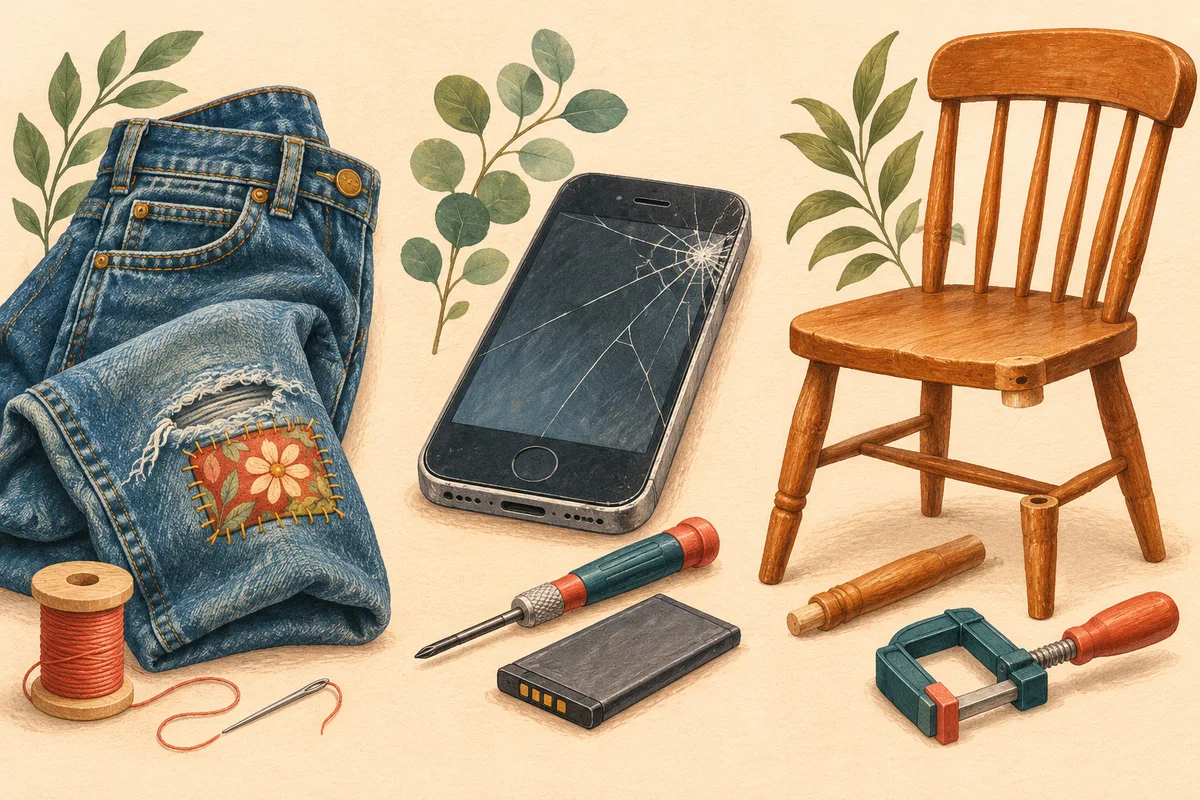
Three everyday objects. Which would you fix, replace or keep using?
Describe something you threw away recently. Could it have been repaired?
Which practical skill have you learned from a family member or online tutorial?
What skill do you wish you knew, and why?
Original, source-informed reading · B1
The skills we used to learn
Imagine that your favourite jeans have a small hole. Would you repair them, ask someone for help or buy another pair? Many people choose the last option, even when the jeans could last much longer.
Repairing things used to be a normal part of daily life for many families. People mended clothes, maintained bicycles and kept basic tools at home. However, we should not imagine that every old product was better. We remember the strong items that survived and often forget the ones that broke.
Some American schools helped students learn practical skills. In traditional Home Economics classes, students might cook, sew or manage a household budget. In Shop classes, they learned to use tools or work with wood and metal. These classes were not identical in every school, and related courses still exist today under other names. Spain has Technology and vocational courses, but not an exact national equivalent of traditional US Home Ec.
Why repair less now? New products can be surprisingly inexpensive, while paying a skilled worker takes money. Some modern objects are also hard to open or need special parts. Even a simple repair can be frustrating when nobody at home knows how to do it.
A growing number of Repair Cafés offer another approach. Volunteers help visitors examine broken objects and sometimes teach them a skill. A successful repair saves an item from the bin. Even an unsuccessful one can help someone understand how a product works.
Perhaps schools should teach more life skills again. But which lessons should students lose to make time? And should it be a school's job to teach every practical skill? The answer may depend on what families, local businesses and community groups can already offer.
This is original classroom writing, not a reproduction of a news article.
Factual policy claims are linked to official sources below.
Before: Predict three objects people might take to a Repair Café.
During: Check your predictions. Why is the café run by volunteers?
After: Would a Repair Café work in your town? What would it need?
No video? Use the fact card
At a Repair Café, volunteers help people with broken household technology. Labour costs can make small professional repairs difficult to offer at a competitive price.
Optional / Cultural context
Home Economics & Shop classes in the US
In many US schools, Home Economics traditionally covered cooking, sewing, budgeting and household life, while Shop or Industrial Arts classes taught tool use, woodwork, metalwork and practical construction. Their availability varied and related subjects still exist, sometimes under the names Family and Consumer Sciences or Career and Technical Education. Spain has Technology and Digitalisation subjects and vocational routes, but no universal one-to-one equivalent of traditional US Home Ec.
Discuss: What skill do you wish you knew?
Who should teach it?
05 / Say what you really think
A conversation worth having
Work in pairs. Listen actively, ask why and respond to each other's ideas.
Were people better at repairs in the past? What evidence would you need?
Have cheap products changed our shopping habits?
What do Home Economics and Shop classes sound like to you?
Which everyday skills should schools teach?
Can YouTube replace learning from a teacher or relative?
Is it fair to expect everyone to repair their own things?
What skill do you wish you knew?
The old toaster has been waiting for its comeback.
Were people better at repairs in the past? What evidence would you need?
06 / Your group has a decision to make
Bring back Life Skills?
Your school can offer one new weekly class. You have to choose five skills from cooking, sewing, money management, bicycle repair, basic DIY, first aid, gardening, electronics and consumer rights. There is only one hour per week.
Before you decide, consider three things:
RepairCan it be fixed safely?
CostIs fixing it worth the money?
WasteWhat happens if you replace it?
Student representative
Choose skills that young people want and will really use.
Teacher
Think about safety, materials, lesson time and the curriculum.
Parent or carer
Think about independence, family needs and costs.
Final outcome: Agree on five skills, put them in order and present a four-sentence argument for your choices.
Useful language
We ought to teach ...
It would be useful because ...
Compared with ..., ...
One disadvantage is ...
Could we compromise by ...?
Optional · Student curiosity corner
Keep Exploring · Read & Watch More
Curious about this topic? Choose one original article or video.
These are optional, not homework. Some are more challenging than the class reading.
Read · A2+ · 5 min
Repair Café International
Explore a community approach to sharing practical repair skills.