Ready-to-teach lesson · B2 · Upper-intermediate · 60 minutes

The Repair Revolution: The throwaway economy: who's responsible?

Distinguish product failure from replacement pressure, evaluate claims and negotiate responsibility.

01 / Talk first · 6–8 minutes

Before we read

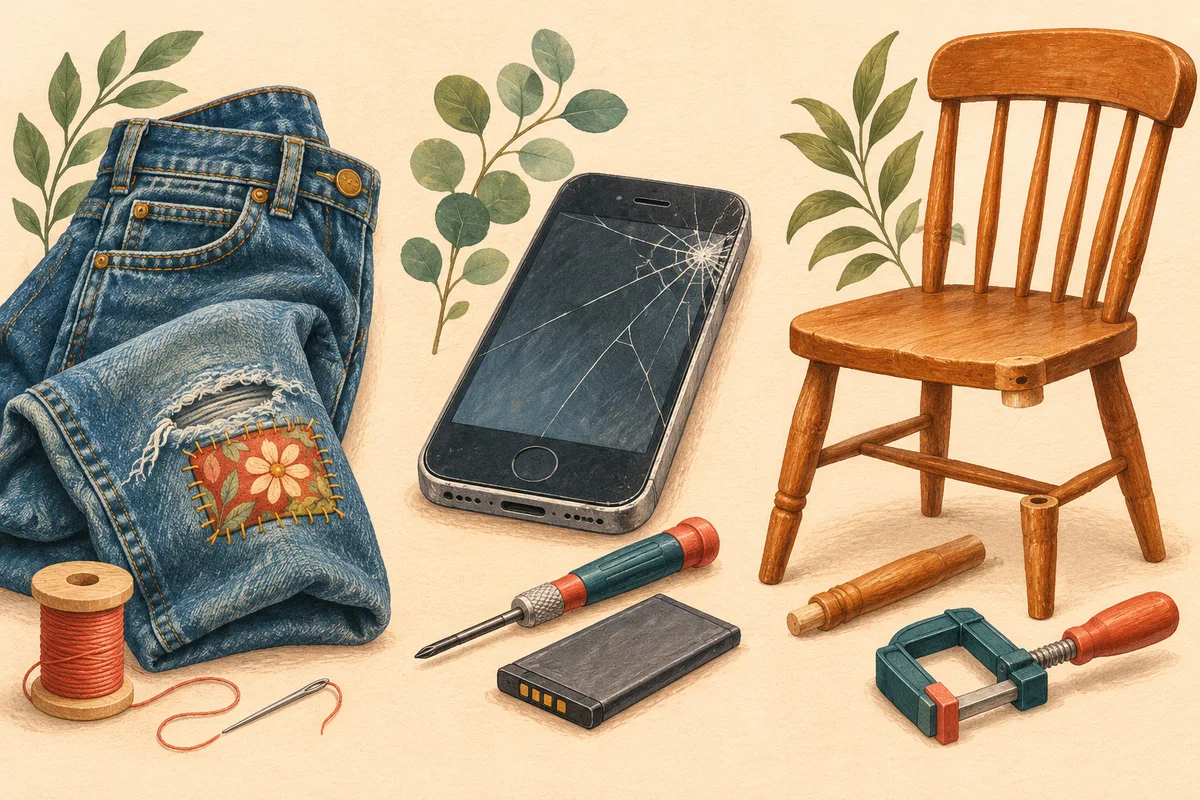
Illustration of patched jeans, a phone with a cracked screen and a wooden chair with a loose leg, with repair tools alongside them
Three everyday objects. Which would you fix, replace or keep using?
  1. When did you last replace a product that still worked?
  2. Is buying an expensive brand a reliable way to get better durability?
  3. What is the difference between something becoming unusable and becoming unfashionable?
Original, source-informed reading · B2

Designed to break—or designed to sell?

A phone with a weak battery, jeans with a small tear, a perfectly good laptop that cannot run new software: each presents a different reason to replace something. Yet modern shopping culture often treats them alike. Rather than asking whether a product can be fixed, we ask what the latest model costs.

It is tempting to say that everything was built to last in the past. Some older appliances were mechanically simpler and easier to open. However, surviving examples do not tell us how many failed. Today's products may also be safer, more efficient or more capable. The real question is not whether every old product was superior, but why repair has become inconvenient or uneconomical in so many cases.

The phrase 'planned obsolescence' describes deliberate strategies that shorten a product's useful life or encourage earlier replacement. A sealed battery or software restriction can make repair harder. But an item failing after a few years is not, by itself, proof of a deliberate plan. Ordinary wear, design trade-offs, manufacturing defects and changing customer preferences may also explain it. Evidence matters.

Fashion illustrates a different kind of obsolescence. A cheap shirt may still be wearable when it is declared out of style. Rapidly changing trends, targeted advertising and low prices encourage customers to buy more frequently. This is sometimes called perceived obsolescence: the product still works, but we no longer want it. The environmental costs of production and disposal may be far less visible than the price tag.

Repair is not automatically the cheapest option. A new small appliance may cost less than the labour needed to diagnose an old one. Missing spare parts can make the calculation worse. Community Repair Cafés, second-hand markets and clothing alterations offer alternatives, but they cannot solve every problem.

EU rules have begun to shift the incentives. Since July 2026, the right-to-repair measures have required manufacturers to offer repairs for specified product groups covered by EU repairability requirements, normally at a reasonable price. Separate EU consumer rules applying from September 2026 strengthen protection against misleading claims about durability and certain early-obsolescence practices. These are targeted measures, not a universal guarantee that anything can be fixed.

Who should change first? Consumers can buy less and maintain what they own. Manufacturers can make parts available and design for repair. Governments can help align prices with environmental costs. Perhaps the most useful question is not who deserves all the blame, but what would make keeping a product genuinely easier than replacing it.

This is original classroom writing, not a reproduction of a news article. Factual policy claims are linked to official sources below.
02 / Vocabulary you can use

Understand it. Then say it.

Reveal the definitions, find examples in the reading and use two new expressions in your own opinion.

Dictionary
Dictionary
Dictionary
Dictionary
Dictionary
Dictionary
Dictionary
Dictionary
Dictionary
Dictionary
Dictionary

Complete these sentences

  1. Fashion marketing can create __________ obsolescence even when clothes still fit.
  2. The warranty gives manufacturers an __________ to improve reliability.
  3. An old product may show normal __________ rather than a deliberate fault.
  4. Making a device waterproof may involve a design __________ with repair access.
03 / Read between the lines

Four checks, with reasons

Choose the best answer and find the evidence in the text.

1. What distinction is central to the article?
2. What does perceived obsolescence mean here?
3. Why can repair be unattractive?
4. Which statement about EU law is accurate?
04 / Short classroom video · Optional

How Does Electronic Waste Impact the Environment?

PBS Above the Noise · Watch 0:00–4:00 only (4 minutes); the complete film is further viewing.

Listen for one cause of e-waste and one tactic that makes repairs harder.

Watch the original video
  1. Before: Predict why people discard electronic products even when they can still work.
  2. During: In the first four minutes, identify two sources of e-waste and one example of a repair barrier.
  3. After: Is it more effective to change consumer habits or product design? Defend your answer.
No video? Use the fact card

Discarded electronics can contain materials that are dangerous when handled badly. Some products are difficult to repair because of glued components, parts restrictions or software barriers. Consumers may also replace devices simply because newer models attract them.

Optional / Cultural context

Home Economics & Shop classes in the US

In many US schools, Home Economics traditionally covered cooking, sewing, budgeting and household life, while Shop or Industrial Arts classes taught tool use, woodwork, metalwork and practical construction. Their availability varied and related subjects still exist, sometimes under the names Family and Consumer Sciences or Career and Technical Education. Spain has Technology and Digitalisation subjects and vocational routes, but no universal one-to-one equivalent of traditional US Home Ec.

Discuss: What skill do you wish you knew? Who should teach it?
05 / Say what you really think

A conversation worth having

Work in pairs. Listen actively, ask why and respond to each other's ideas.

  1. When does a product's failure justify accusing a manufacturer of planned obsolescence?
  2. Are premium brands usually worth their price in the long run?
  3. Does fast fashion respond to consumer demand or create it?
  4. Should repair services pay lower taxes than new-product retailers?
  5. Could a repairability score influence your next purchase?
  6. Is recycling enough if we continue to buy at the same rate?
  7. Who should carry the greatest responsibility: consumer, company or government?

The old toaster has been waiting for its comeback.

Our chameleon mascot working at a desk
When does a product's failure justify accusing a manufacturer of planned obsolescence?
06 / Your group has a decision to make

The consumer responsibility summit

A city wants to reduce the number of working products thrown away. It can fund public repair workshops, give repair vouchers, introduce school life-skills workshops or run a campaign against disposable fashion. Budget allows only two actions.

Before you decide, consider three things:

RepairCan it be fixed safely?
CostIs fixing it worth the money?
WasteWhat happens if you replace it?
Consumer group

Demand affordable choices and clear information, not guilt.

Local repair shop

Explain wages, equipment costs and demand for skilled jobs.

Retailer

Defend reasonable prices and customer choice; propose a workable compromise.

Environment group

Prioritise waste reduction and durable behaviour change.

Final outcome: Agree on two funded policies, a success measure and one objection to your plan.

Useful language

  • It's tempting to assume that ...
  • That doesn't necessarily follow.
  • A more convincing explanation is ...
  • We need to distinguish ... from ...
  • I see the trade-off, but ...
  • The most realistic intervention would be ...
Optional · Student curiosity corner

Keep Exploring · Read & Watch More

Curious about this topic? Choose one original article or video. These are optional, not homework. Some are more challenging than the class reading.

Read · B1+ · 4 min

EU: new consumer right to repair

Official 2026 overview of the products and obligations covered.

Open original source
Read · B2+ · 6 min

Smartphone repairability scores

Find the repairability rating, spare-parts and update requirements.

Open original source
Watch · B2+ · 10:20

PBS: where electronic waste goes

Investigates planned obsolescence and global electronic waste.

Open original source
Watch · B2+ · 12:35

DW Planet A: can fast fashion be green?

Challenges the sustainability claims of major clothing brands.

Open original source
Think about it: Which change would reduce waste most?

Found a better article or video? Suggest a future lesson.