Ready-to-teach lesson · C1 · Advanced · 60 minutes

The Repair Revolution: Can the right to repair change consumer culture?

Analyse market incentives, qualify environmental claims and develop a feasible repair policy.

01 / Talk first · 6–8 minutes

Before we read

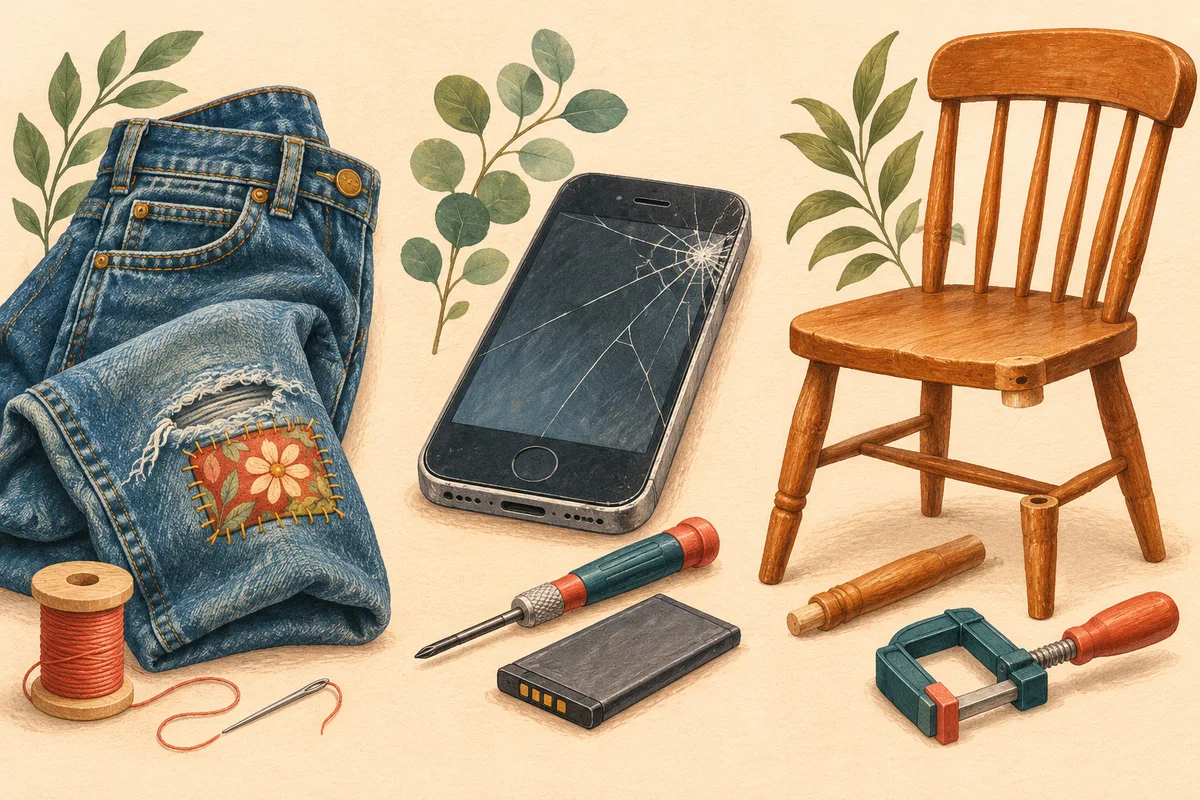
Illustration of patched jeans, a phone with a cracked screen and a wooden chair with a loose leg, with repair tools alongside them
Three everyday objects. Which would you fix, replace or keep using?
  1. Why can the privately cheapest decision be environmentally costly for society?
  2. When is a manufacturer's control over parts or software defensible?
  3. Which practical skill do you wish you had learned at school?
Original, source-informed reading · C1

A right on paper, a repair in practice

A broken washing machine may present consumers with an oddly irrational choice. Replacing a modest component could extend the appliance's life by years, yet the diagnostic visit, labour and replacement part may together approach the price of a new model. The decision to discard it can be financially sensible for an individual while socially wasteful. That gap between private price and wider cost sits at the heart of the repair debate.

It would be convenient to blame manufacturers alone. Some products are sealed, software-dependent or difficult to dismantle, and exclusive parts arrangements can limit independent repairers. Nevertheless, genuine design trade-offs exist: waterproofing, miniaturisation, safety certification and energy efficiency may conflict with easy access. Moreover, expensive labour is not necessarily a market failure. Skilled repair workers deserve a living wage, even when factory-made replacements are surprisingly cheap.

Consumers also contribute to the pressure to replace. Fast-fashion advertising can make wearable clothes feel obsolete, while frequent phone launches encourage upgrades that offer little practical improvement for some users. Yet 'planned obsolescence' should not be used as a catch-all accusation. A battery deteriorating naturally, a company deliberately withholding a feasible part and a customer tiring of an unfashionable colour involve quite different mechanisms. Robust claims need evidence of intention, design choices and realistic alternatives.

In July 2026, EU right-to-repair provisions began applying to specified categories of technically repairable products covered by relevant EU law. Manufacturers must provide repairs within a reasonable time and at a reasonable price unless free, and the framework supports spare-parts access. Where a consumer chooses repair instead of replacement within the seller's legal liability period, the protection is extended by at least twelve months. These rights are meaningful, but they are not an unconditional promise of unlimited free repairs for every object.

Separate EU rules applicable from September 2026 seek to improve durability information and curb misleading environmental claims and some practices associated with premature obsolescence. New EU requirements for certain smartphones and tablets also address access to parts, software support and repairability scores. Whether consumers notice these labels, understand their limitations or act on them remains a behavioural question.

Repair policy could also redistribute economic opportunity. Independent workshops might gain customers and local jobs, while consumers could keep products longer. Yet smaller manufacturers could struggle with parts inventories, compliance costs and documentation obligations. Low-income households may be unable to pay a higher upfront price for a product that is cheaper over ten years. A durable-product market could therefore become more unequal unless policymakers consider cash flow as well as lifetime value.

Repair Cafés demonstrate what communities can achieve when skills circulate freely, but volunteer labour cannot replace an entire professional sector. Nor can nostalgia for school Shop and Home Economics classes substitute for a curriculum decision: who would teach these skills, with what equipment, and at the expense of which subjects? The real revolution would combine repairable design with affordable services, informed customers and the practical confidence to seek help. Legislation can remove some barriers; it cannot repair a culture by decree.

This is original classroom writing, not a reproduction of a news article. Factual policy claims are linked to official sources below.
02 / Vocabulary you can use

Understand it. Then say it.

Reveal the definitions, find examples in the reading and use two new expressions in your own opinion.

Dictionary
Dictionary
Dictionary
Dictionary
Dictionary
Dictionary
Dictionary
Dictionary
Dictionary
Dictionary
Dictionary

Complete these sentences

  1. Pollution that buyers do not pay for is a negative __________.
  2. A product may be costly initially but offer better __________ over ten years.
  3. Manufacturers argue that access to __________ software may create security risks.
  4. Small firms need support with legal __________ and documentation.
03 / Read between the lines

Four checks, with reasons

Choose the best answer and find the evidence in the text.

1. What economic tension opens the article?
2. Why does the author resist treating all failures as planned obsolescence?
3. Which group might face a cash-flow barrier even when durable goods save money later?
4. What limitation does the conclusion place on legislation?
04 / Short classroom video · Optional

What is the right to repair?

European Parliament · Watch up to 4 minutes; pause to check the difference between a proposed measure and a current rule.

Separate the legal proposal, consumer benefit and potential limitations.

Watch the original video
  1. Before: What problem might a right-to-repair law solve—and what might it leave untouched?
  2. During: Note one consumer right, one anticipated market benefit and one unanswered implementation question.
  3. After: Propose a safeguard for either small manufacturers or low-income consumers.
No video? Use the fact card

EU measures promote repairs for certain products and make durability information easier to find. However, the scope, enforcement, cost and repair ecosystem matter; legal rights alone do not guarantee attractive repairs.

Optional / Cultural context

Home Economics & Shop classes in the US

In many US schools, Home Economics traditionally covered cooking, sewing, budgeting and household life, while Shop or Industrial Arts classes taught tool use, woodwork, metalwork and practical construction. Their availability varied and related subjects still exist, sometimes under the names Family and Consumer Sciences or Career and Technical Education. Spain has Technology and Digitalisation subjects and vocational routes, but no universal one-to-one equivalent of traditional US Home Ec.

Discuss: What skill do you wish you knew? Who should teach it?
05 / Say what you really think

A conversation worth having

Work in pairs. Listen actively, ask why and respond to each other's ideas.

  1. Would repair vouchers correct a market failure or merely subsidise expensive repairs?
  2. How should regulators judge a 'reasonable' repair price?
  3. Where should safety and software security limit independent repair?
  4. Could repairability labels change the premium-brand business model?
  5. Is a longer-lasting, inefficient appliance necessarily the greener choice?
  6. Could schools revive practical skills without reviving gender stereotypes?
  7. What would make the repair economy accessible to poorer households?
  8. What evidence would show that recent EU rules are working?

The old toaster has been waiting for its comeback.

Our chameleon mascot working at a desk
Would repair vouchers correct a market failure or merely subsidise expensive repairs?
06 / Your group has a decision to make

Design a city's repair incentive

Your city has a limited fund to reduce discarded electronics and appliances. Propose a pilot combining one financial incentive, one skills initiative and one way to evaluate results. You must address cost, equity and unintended effects.

Before you decide, consider three things:

RepairCan it be fixed safely?
CostIs fixing it worth the money?
WasteWhat happens if you replace it?
Consumer advocate

Demand affordable repairs and clear information for low-income households.

Repair-business owner

Protect skilled wages and propose realistic capacity.

Environmental analyst

Request evidence of avoided waste rather than promotional claims.

City finance officer

Control costs, deadweight subsidies and administrative burden.

Final outcome: Present a two-minute pilot proposal: eligibility, budget logic, success metric, equity safeguard and main risk.

Useful language

  • This creates a perverse incentive to ...
  • That distinction is material because ...
  • The evidence falls short of establishing ...
  • A proportionate response would be ...
  • We would need to monitor ...
  • There is an equity concern insofar as ...
Optional · Student curiosity corner

Keep Exploring · Read & Watch More

Curious about this topic? Choose one original article or video. These are optional, not homework. Some are more challenging than the class reading.

Read · B1+ · 4 min

EU: new consumer right to repair

Official 2026 overview of the products and obligations covered.

Open original source
Read · B2+ · 6 min

Smartphone repairability scores

Find the repairability rating, spare-parts and update requirements.

Open original source
Read · C1+ · 6 min

Protection against early obsolescence

How the EU addresses misleading durability and green claims.

Open original source
Watch · B2+ · 12:35

DW Planet A: can fast fashion be green?

Challenges the sustainability claims of major clothing brands.

Open original source
Watch · B2+ · Short video

European Parliament: right to repair

A short institutional introduction; check it against the current rules.

Open original source
Think about it: What is the most credible policy evidence?

Found a better article or video? Suggest a future lesson.