Fictional examples welcome. You never need to disclose your income, bills or family circumstances.
Talk first
What would justify overruling a reassuring aggregate with troubling household evidence?
Is affordability a statistical property, a political judgment or a relationship between resources and obligations?
The price of a reassuring story
Economic narratives often compress three propositions into one: output is expanding, average purchasing power is improving, and people are better off. None follows automatically from the others. GDP concerns production, real earnings concern a price-adjusted income measure, and welfare encompasses circumstances those measures only partly capture. The problem is not that aggregation is illegitimate. It is that a useful summary can become an unwarranted verdict on experiences outside its scope.
Affordability is relational. A price that one household treats as an irritation may force another to reorganize work, care or meals. Exposure depends on contractual obligations, accumulated buffers and the availability of substitutes, not merely income rank. A homeowner with stable housing costs and a renter facing a new contract may interpret the same inflation release very differently. Neither reaction, on its own, settles the validity of the index.
Our evidence separates three questions: how the annual rate has moved, how selected supermarket products have changed, and how much the general price level has accumulated over distinct horizons. Each has a legitimate use. The temptation is to smuggle one answer into another question: to present slowing inflation as recovered affordability, a conspicuous product increase as representative inflation, or a nominal pay increase as an unambiguous gain in living standards.
Even a matched comparison of gross wage growth and CPI cannot resolve every dispute. Composition effects can alter average earnings, household baskets differ, and taxes or transfers mediate disposable resources. Nor does a modest real increase over a recent interval establish restoration to an earlier baseline. Precision in a calculation is valuable only when the surrounding inference is equally disciplined. A narrow estimate should retain a narrow claim.
Household adaptation complicates interpretation further. Switching products, postponing replacement or investing more time in shopping may keep recorded spending stable while changing the quality, convenience or reliability of what people receive. Spending more can likewise reflect higher prices rather than greater consumption. Treating expenditure alone as revealed satisfaction overlooks the constraints under which choices are made, although discounting all such choices would disregard genuine agency.
There is also a distribution of adjustment costs. A strategy that saves money through preparation may shift work into the home. A bargain requiring cash up front excludes someone who could benefit most from it. Reducing social spending can diminish networks that make other difficulties manageable. The question is not whether people should ever tighten their belts, but whether the proposed belt-tightening is feasible, consequential and fairly distributed.
Price regulation raises a parallel problem of scope. A temporary ceiling aimed at a specific market disruption is analytically different from a general attempt to suppress prices without addressing scarcity. Whether intervention preserves access depends on coverage, enforcement, supplier viability and the response of demand. Subsidizing the difference may sustain supply but relocates the burden to public finance. An attractive headline cannot eliminate that incidence.
Alternatives also require scrutiny. Targeted transfers can preserve consumer choice while creating exclusion through eligibility and administrative friction. Tax reductions may be incompletely passed through. Competition policy and additional supply may address durable causes while leaving immediate hardship unresolved. A credible package may therefore combine measures whose time horizons differ, provided its rationale and costs remain intelligible.
The task is to make a judgment without claiming certainty that the evidence cannot supply. State the harm to be prevented, the counterfactual against which success is assessed, and the people whose welfare matters most. Then identify what observation would count against the proposal. A policy defended only by its intentions, or a narrative insulated from contrary evidence, is not strengthened by sophisticated vocabulary.
Device voice; no downloadable recording.
Original classroom writing. Research snapshot: 13 November 2026.
The story in three charts
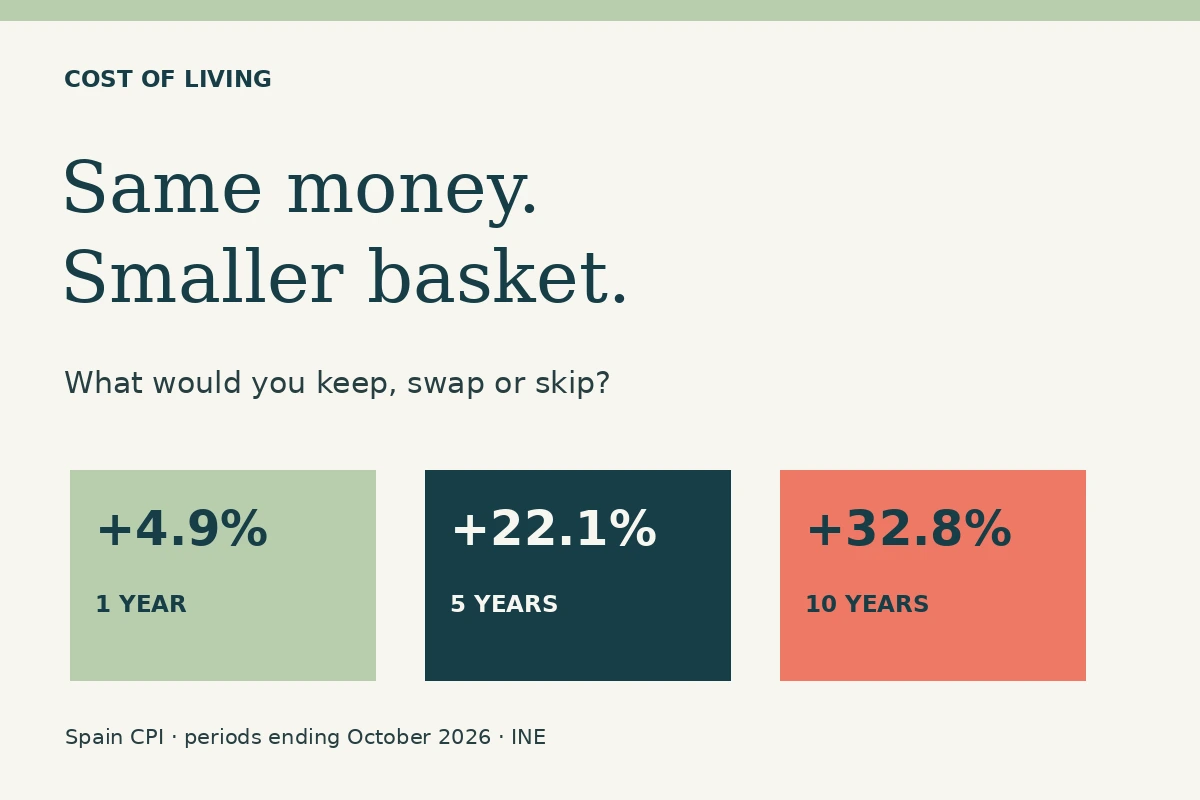
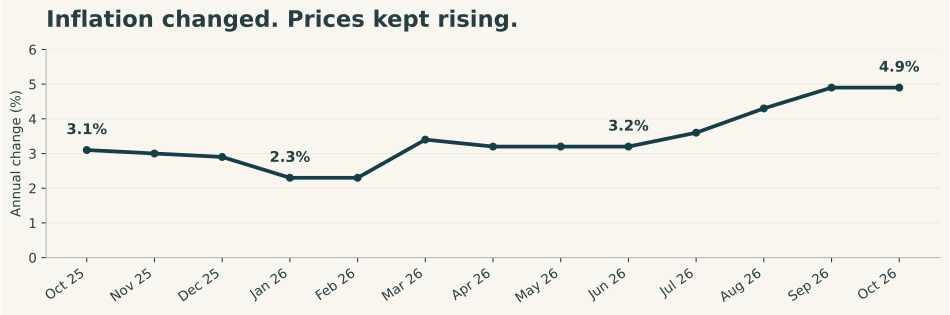
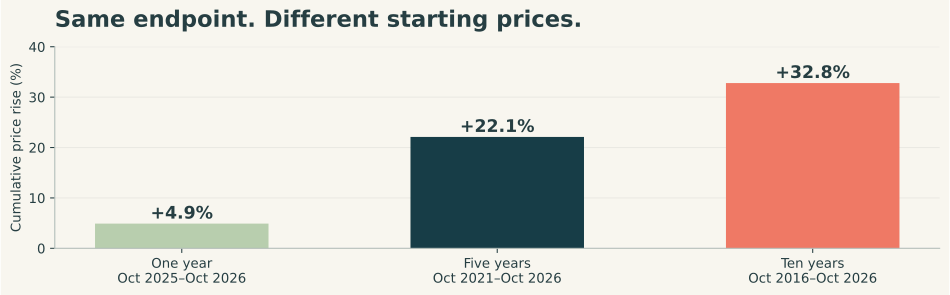
Spain · annual CPI rate, each month compared with the same month a year earlier. These are not month-on-month increases. INE; October 2025–October 2026. Latest release: 13 November 2026.Spain · national general CPI, same-month comparisons ending October 2026. One year: +4.9%; five years: +22.1%; ten years: +32.8%. The periods overlap: do not add them. Illustrative equivalent of a €100 basket: €104.90, €122.10 or €132.80, respectively. Not the prices of a specific grocery list.
Identify one legitimate inference and one overreach for each visual.
If a basket rises 32.8%, would a 32.8% fall return it to its starting price? Explain.
How could a comparison that is mathematically correct still misrepresent lived affordability?
Do not add overlapping periods. A slowing positive rate is not a falling price level.
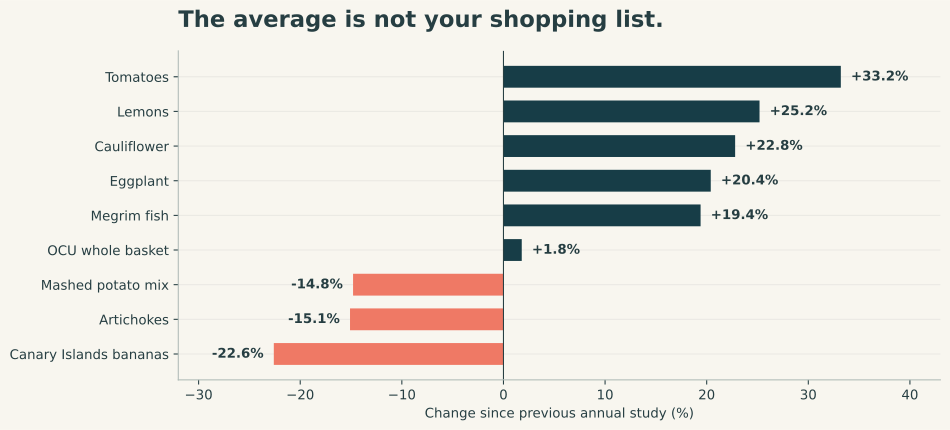
Selected products from OCU’s 2026 annual supermarket study compared with its previous study. Prices collected April–May 2026. Percentage changes, not euro prices; selected examples are not a representative average. The whole basket also includes household and hygiene products.
The calculation is sound; the inference depends on ___.
That framing conflates ___ with ___.
Against which counterfactual are we assessing ___?
The measure is defensible to the extent that ___.
I would revise my position if ___, but not merely because ___.
Find the evidence
Which three propositions does the opening separate?
How can unchanged spending conceal a loss?
Why does a subsidy not erase a price-control burden?
What makes the final proposal open to scrutiny?
Answer in pairs and identify a supporting sentence. Keep opinion separate from a reading fact.
Budget food, with a side of economics
Hamburger Helper stretches added ground beef with boxed pasta and sauce mix; instant ramen supplies the familiar US student-budget counterpart. In 2025, David Hebert argued in The Daily Economy that budget-food demand can expose pressure obscured by aggregate growth. The informal “index” invites a useful question, not a causal verdict: sales revenue need not track sales volume, and substitution need not establish falling income. Which inexpensive meal would remain your choice even if your budget doubled?
Spain, Q2 2026 vs Q2 2025: average gross wage cost per worker rose 4.0%; CPI annual rates were 3.2% in April, May and June. Using these rounded figures gives approximately 0.8% real growth: 1.04 ÷ 1.032 − 1. This is a broad average comparison—not each worker’s pay raise, median earnings or take-home income.
In an ONS survey of adults in Great Britain in August 2026, 59% reported spending less on non-essentials because of rising living costs, 43% shopping around more and 38% spending less on food shopping and essentials. These are self-reports, not Spanish statistics; people could take more than one action.
A worker receives 3% more pay while their usual basket costs 5% more. Has the pay rise improved what they can buy? What else would you want to know?
Optional authentic listening
Federal Reserve Education · Inflation
Watch only the opening three minutes, or stop earlier after the basket explanation. Historical prices are examples from the video, not today’s prices. This is a US explainer; its policy target and methodology require context.
Separate the measure described from the welfare judgments it might invite.
Evaluate the explanatory scope of a basket-based comparison.
No playback? Teacher-read alternative
Inflation is a broad increase in prices over time. A low price in the past does not prove something was easier to afford, because pay was different too. A price basket combines many purchases. It describes an average pattern, while households spend their money differently.
Official page and transcript checked; video playback has not been verified here. The fallback is original classroom narration, not an authentic transcript.
What would you protect?
Which dimensions of welfare can a cost-of-living index reasonably be expected to capture?
When should qualitative household evidence alter interpretation of an aggregate?
How might substitution conceal changes in welfare?
Which counterfactual would make a “recovery” claim meaningful?
Who performs the extra labor behind apparently successful economizing?
Is protecting a minor pleasure defensible when a household runs a deficit? Under what conditions?
What would distinguish constrained choice from a stable preference?
Which saving strategy could deepen vulnerability despite reducing current spending?
Specify a price intervention narrow enough to evaluate and broad enough to matter.
How should uncertainty about shortages affect the burden of proof?
What exit rule would balance credibility with the risk of withdrawing support prematurely?
Could a policy improve welfare while making a headline inflation measure look worse? Explain a mechanism.
What observation would falsify your preferred explanation of current pressure?
Can personal experience establish a general trend? What else is needed?
How would you communicate uncertainty without appearing evasive?
Which compromise could you defend publicly even if it were not your first choice?
The calculation is sound; the inference depends on ___.
That framing conflates ___ with ___.
Against which counterfactual are we assessing ___?
The measure is defensible to the extent that ___.
I would revise my position if ___, but not merely because ___.
Keep, swap or skip
Use the fictional budget as a stress test, not a representative household. Propose a package that addresses the €80 shock while preserving meaningful choice. State its distributional incidence, a plausible counterfactual, an adverse scenario, two evaluation measures and an exit or revision rule.
Item
Euros per month
Housing and bills
€1050
Food and household goods
€420
Transport
€160
Health and essential care
€90
Phone and internet
€60
Social life and subscriptions
€120
Savings / emergency buffer
€100
Income €2,100 · current spending €2,100 · new cost €80.
Possible changes—fictional estimates, not guaranteed savings
Possible change
Monthly saving
Switch some brands / reduce food waste
€25
Cancel one subscription
€15
Two fewer takeout meals
€30
Walk or use an existing bus pass for suitable trips
€20
Renegotiate phone plan
€10
Delay a non-urgent purchase
€30
Reduce the savings contribution this month
€40
Compare quality, time, transport and access. Do not cut essential care or recommend skipping meals.
Final outcome: Agree on a plan, defend one protected priority and explain a tradeoff.
The calculation is sound; the inference depends on ___.
That framing conflates ___ with ___.
Against which counterfactual are we assessing ___?
The measure is defensible to the extent that ___.
I would revise my position if ___, but not merely because ___.
Should the government step in?
Compare the three options. What problem do you want to solve first?
Temporary price ceiling
Set a legal maximum for selected essential goods. It may provide immediate relief; if set below a viable supply price without support, it can discourage supply or create shortages. Define the product, duration and enforcement.
Targeted support
Give eligible households cash or vouchers. This can focus help on need; eligibility rules, missed applicants, funding and price effects need attention.
Tax relief and competition
Reduce selected consumption taxes or improve competition and price transparency. Benefits depend on how much reaches shoppers; tax cuts cost public revenue and competition measures can take time.
Who benefits? Who pays? What could go wrong? How would you check whether it worked?
Take it further
Compare two fictional households with identical income but different rent, care and transport commitments. Construct the strongest case for and against giving them equal public support.
Exit ticket
One useful expression. One claim you can support with data. One choice or opinion you reconsidered.
60-minute route: warmer 5; reading and comprehension 12; charts 8; vocabulary and useful language 8; selected discussion 12; decision and exit ticket 15. Optional media replaces part of discussion; add the extension and policy clinic for 90 minutes.
Require precision about what each measure warrants. Do not treat GDP as an income average or use the article’s millionaire analogy as a literal GDP model. Encourage synthesis and explicit epistemic limits rather than jargon density.
Reading answers
Output growth, average purchasing-power gains and improved welfare.
People may substitute lower-quality options or contribute more time and effort.
It can move the burden to public finance.
An explicit counterfactual, welfare priorities and evidence that could count against it.
Chart answers
Accept claims bounded by geography, period, product selection and the measured variable; reject generalizations beyond them.
No. The reversal is 1−1/1.328, about 24.7%.
Different household weights, obligations, hours and net income can make the same aggregate comparison insufficient.
Budget example: €25 brand/waste changes + €15 subscription + €30 fewer takeout meals + €10 phone plan = €80. These are fictional estimates. Do not count the same food saving twice. Teen plan: picnic €20 total or free local event up to €10 with optional snacks; café €28 exceeds €24.
Listening guidance: Old prices need old pay for an affordability comparison; a basket measures a collection, not each household. Answer using the excerpt actually played; use the original fallback if unavailable.
Anticipated pitfalls: Slower positive inflation is not falling prices; cumulative periods overlap; percent and percentage points differ; nominal sales and sales volumes differ; cheap food is not automatically an “inferior good.” The food aside should take about two minutes, not become a major section.